
Route-planning know-how usually lives in one person’s head. When that person is out, deliveries suffer. Here is why it happens, how to tell how exposed you are, and how AI-assisted planning turns that know-how into a company asset – without replacing the dispatcher.
Every distribution company has one. The dispatcher who knows that the hardware store on Route 9 only takes deliveries before 10 a.m., that the new driver should not get the downtown loop on a Friday, and that two particular customers always order together. Routes go out on time, trucks are full, customers are happy.
Then that person takes a week off.
Suddenly routes take hours to build, trucks leave half-empty, drivers call the office from the road, and customer service spends the day apologizing. Nothing in the business changed – except that the knowledge that ran it was not in the building.
The hidden risk in route planning
Most companies would never accept a single point of failure in their ERP, their servers or their warehouse equipment. Yet route planning – the step that decides delivery cost and customer experience every single day – often depends entirely on the experience of one or two people.
That knowledge is rarely written down, because it is not a procedure. A procedure says “trucks leave by 7:30.” Experience is hundreds of small judgments:
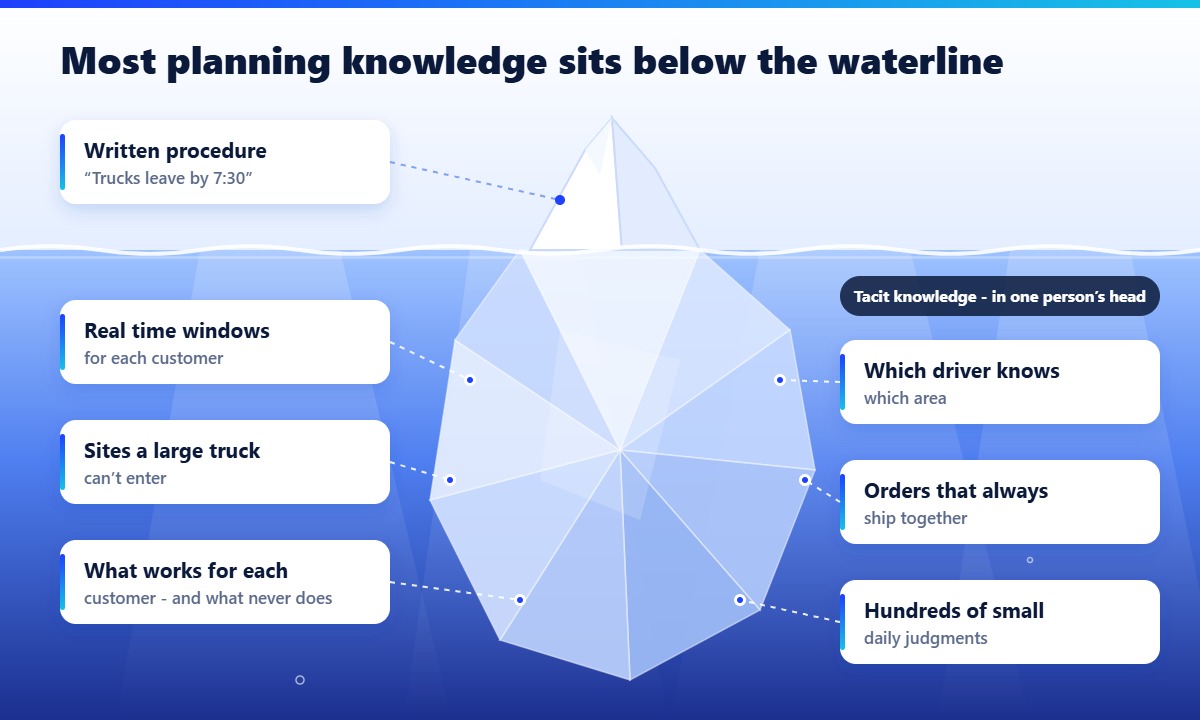
- which customers have strict time windows, and which are flexible in practice;
- which driver knows which area, and which vehicle fits which site;
- how weight, volume and pallet counts really load onto a truck;
- which orders can be combined, and which always cause trouble.
When the dispatcher is on vacation, sick, or leaves the company, those judgments leave with them. The result is not just a bad week. It is a business that cannot grow its delivery operation faster than it can find and train another expert.
Why documents and generic routing tools fall short
Many teams try to fix the problem with documentation or a basic routing tool. Both help, but neither captures how your operation actually works.
A document describes the rules someone remembered to write down. A generic routing engine optimizes distance and time – but it does not know that a customer’s dock is closed on Wednesdays, or that your best planner always moves a certain stop to the first slot. So the planner keeps correcting the plan by hand, and the real knowledge stays in their head.
A different approach: let the system learn from the dispatcher
The better approach keeps the dispatcher in charge and lets the planning system learn from them. In practice, it is a simple loop:
- The system proposes a plan from live ERP data – orders, customer time windows, driver schedules, weights, volumes and pallet counts.
- The planner adjusts it – moving stops, swapping drivers or changing the order, exactly as they do today.
- The system learns from every adjustment. Each change teaches it something about how your operation really works.
- The next plan is closer. Over time the plan needs fewer and fewer corrections – until almost anyone on the team can run it.
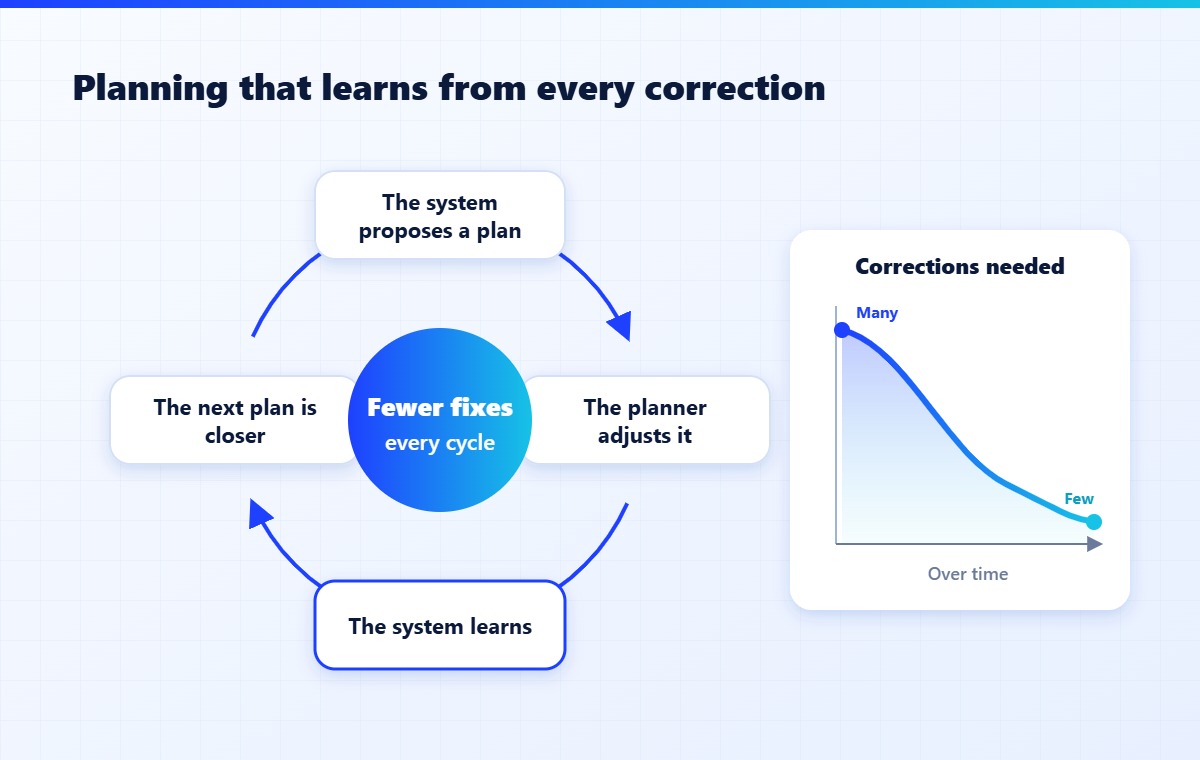
The know-how that used to live in one person’s head becomes part of the company’s system. The dispatcher is no longer a bottleneck; they become the person who trained it – and they spend their time on exceptions instead of rebuilding the same routes every morning.
This is how route planning works in ShipSnap, the SPS delivery platform: the AI proposes, the dispatcher corrects, and every correction is kept as company knowledge.
What changes for the business
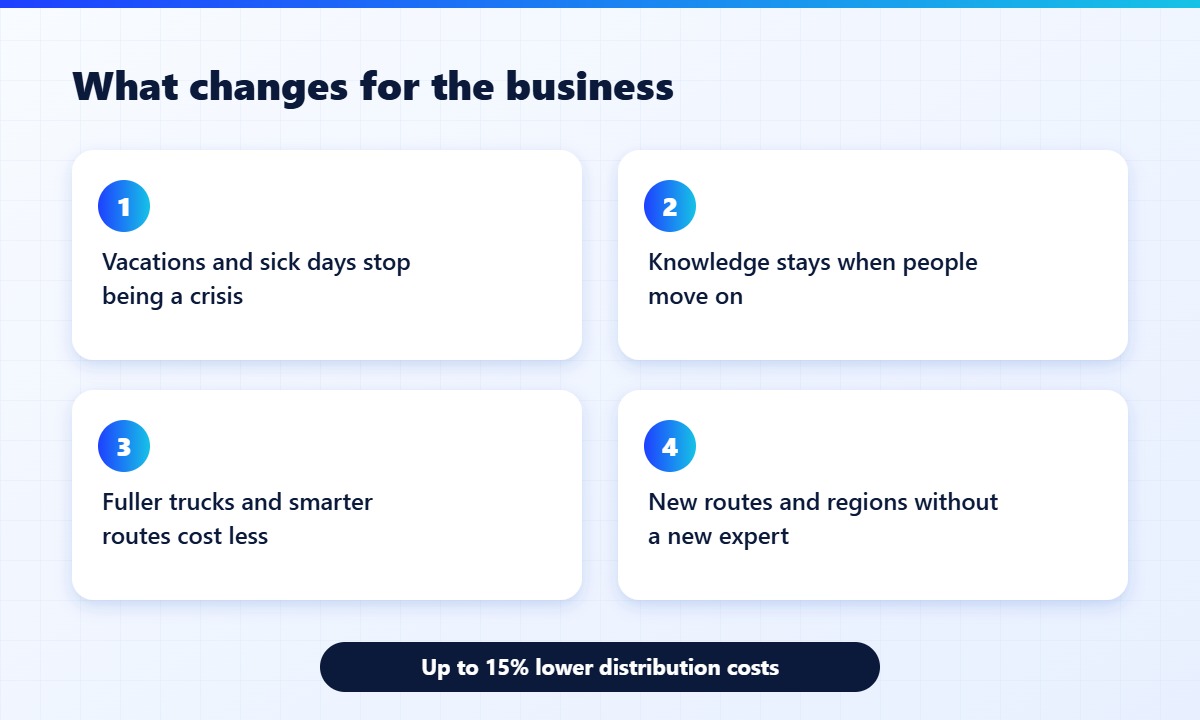
Vacations and sick days stop being a crisis. When the planner is away, someone else runs the plan the system has learned, instead of starting from scratch.
Knowledge stays when people move on. If a key employee leaves, the experience they built over years does not walk out the door with them.
Lower delivery costs. Better-loaded trucks and smarter routes reduce distribution costs – ShipSnap customers see savings of up to 15%.
Room to grow. Adding routes, drivers or a new region no longer depends on finding another expert planner.
Closing the loop with proof of delivery
Planning is only half of the picture. Once routes are out, drivers capture proof of delivery in the app – signature, photo, time and location – even offline. Every delivery is written back to the ERP in real time, so finance, customer service and the dispatcher all work from the same verified record. That data also feeds the next day’s planning.
Where to start
If you are not sure how exposed your operation is, ask one question: “What happens to tomorrow’s routes if our dispatcher does not come in?”
If the honest answer is “it would be a mess,” that is the risk worth fixing first.
ShipSnap connects to SAP Business One and to other ERPs such as Oracle, NetSuite, Priority and IBM AS/400 – directly or through Winsert, the SPS integration hub – so the planning knowledge you build stays connected to the rest of your business.
See how planning learns from your dispatcher – book a ShipSnap demo →